Category: Guides & News

Buying safely, getting your money back, how sellers are checked, and what’s new on PlayerBay. Start here if you’re new to buying game accounts, currency or items, or if you want to know exactly what happens after you pay.

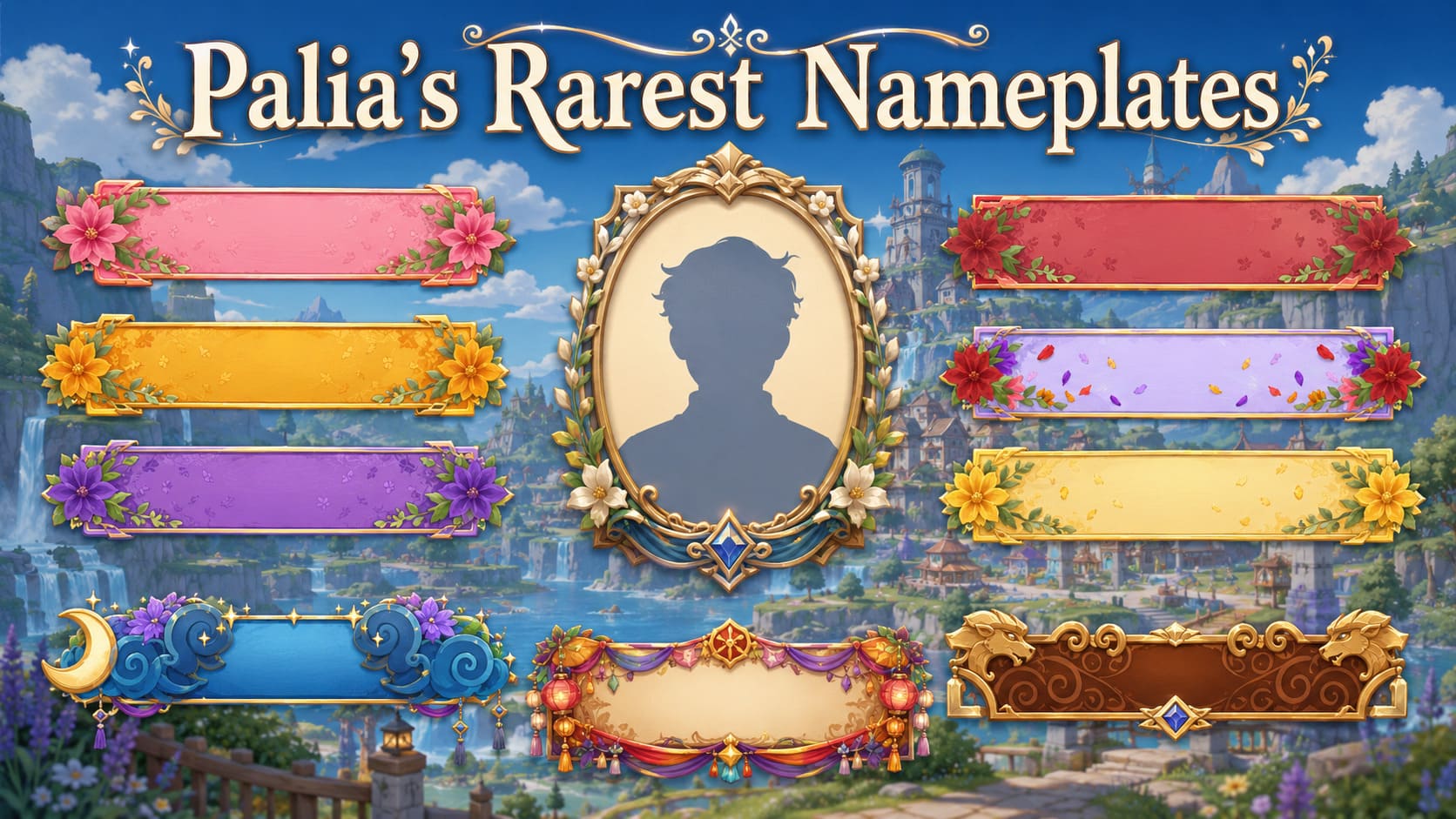
  • Rarest Palia Nameplates and How to Get Them (2026)

    Rarest Palia Nameplates and How to Get Them (2026)

    Palia nameplates are cosmetic frames that appear around a player’s name, giving collectors another way to show off event participation, difficult accomplishments, seasonal rewards, or premium purchases. Some can still be earned through regular gameplay, while others were tied to events that have already ended.

    That difference is what makes certain nameplates considerably rarer than others. A nameplate might have an ordinary in-game rarity label but still be difficult to find because its event only ran once, its reward required a large amount of event currency, or its original unlock route is no longer available.

    This guide covers the rarest Palia nameplates, how each one was originally obtained, which events they came from, and whether you can still unlock them. When an event has passed or the normal method is unavailable, you can also browse Palia items and individual nameplate services on PlayerBay.

    Last updated: August 3, 2026. Palia events, seasonal shops, reward rotations, and marketplace availability can change. Check the current in-game event schedule and individual listing details before making a decision.

    What Are Nameplates in Palia?

    Nameplates are account-bound cosmetics equipped through the Collections menu. They do not improve your tools, skills, inventory space, or character statistics. Their value comes from appearance, collection progress, and the history behind how they were earned.

    Palia nameplates have been distributed through several different systems:

    • Limited seasonal events: Luna New Year and Maji Market rewards.
    • Temporary Bulletin Board bundles: Seasonal collection objectives that were only available during a specific content period.
    • Recurring world activities: Random rewards from the Flower Bloom Event.
    • Home Tours: Rewards for receiving reactions or spending Tour Tickets.
    • Premium purchases: Nameplates included with paid supporter packs.
    • Permanent progression: Quests, Lunar Paths, and special currency stores.

    The rarest nameplates are usually those whose original acquisition method is currently closed, retired, highly random, or expensive in time and event currency.

    What Makes a Palia Nameplate Rare?

    There is no official leaderboard ranking every Palia nameplate from most common to rarest. For this guide, rarity refers to practical scarcity rather than only the rarity label shown on an item.

    • Current availability: A retired reward is naturally scarcer than one that can be earned every day.
    • Event frequency: Annual and one-time events create smaller acquisition windows.
    • Random reward chances: Flower Bloom nameplates can still require repeated participation because the reward is not guaranteed.
    • Currency requirements: Event nameplates may require thousands of tickets or envelopes.
    • Accomplishment requirements: Some rewards require completing several tiers of a stamp card or collecting large numbers of reactions.
    • Purchase restrictions: Premium nameplates may only be included inside a larger paid bundle.
    NameplateOriginal MethodCurrent AvailabilityPlayerBay
    Year of the RiffrocLuna New Year 2026 stamp-card rewardEvent window has endedCheck availability
    New Year SnakeLuna New Year 2025, 6,000 Lucky EnvelopesEvent window has endedCheck availability
    Blushing BlossomsMidsummer Flowers Bulletin Board BundleNo normal active unlock routeCheck availability
    Firey BlossomsMidsummer Gift Bag Bulletin Board BundleNo normal active unlock routeCheck availability
    Royal BlossomsMidsummer Decor Bulletin Board BundleNo normal active unlock routeCheck availability
    Vivid BlossomsMidsummer Feast Bulletin Board BundleNo normal active unlock routeCheck availability
    Bountiful BlossomsMidsummer’s Daydream: OutroNo normal active unlock routeCheck availability
    Dawnspur DevoteeRoyal Highlands Supporter PackPaid bundle where supportedCheck availability
    Maji MarketChapaa Tchotchkes for 6,000 Maji Market TicketsRecurring limited eventCheck availability
    Bluetiful BlossomsRandom Flower Bloom Event rewardObtainable, but randomCheck availability
    Midnight BlossomsRandom Flower Bloom Event rewardObtainable, but randomCheck availability
    Sunny BlossomsRandom Flower Bloom Event rewardObtainable, but randomCheck availability

    Year of the Riffroc Nameplate

    The Year of the Riffroc Nameplate was introduced during Luna New Year 2026. It was connected to Zeki’s Lucky Catch and required players to complete the Get in My Belly! – III Stamp Card accomplishment.

    This was not a reward players could obtain simply by logging in. They had to participate in the event and progress far enough through the associated accomplishment while Luna New Year was active.

    Because the 2026 Luna New Year event has ended, the normal event route is not currently open. That makes Year of the Riffroc one of the strongest examples of a genuinely limited Palia nameplate.

    Players looking specifically for this cosmetic can review the Year of the Riffroc Nameplate listing on PlayerBay. Confirm current unlock availability with the seller before ordering because event-dependent services may only be possible during certain rotations or through methods described in the listing.

    New Year Snake Nameplate

    The New Year Snake Nameplate came from the 2025 Luna New Year celebration. Players could purchase it from Zeki’s Lucky Catch for 6,000 Lucky Envelopes.

    The 2025 Luna New Year event ran from January 23 through February 20, 2025. Players who did not collect enough Lucky Envelopes before the event ended lost access to its normal purchase method.

    Annual event rewards can be especially collectible because returning celebrations may introduce a new yearly theme instead of restoring every previous reward. A future rotation is always possible, but players should not assume the New Year Snake will automatically return during the next Luna New Year.

    You can check the New Year Snake Nameplate service if the original 2025 event was missed.

    Rare Midsummer Blossom Nameplates

    The Midsummer blossom set includes some of the hardest nameplates to obtain through ordinary gameplay today. These cosmetics were connected to limited Bulletin Board bundles and the Midsummer’s Daydream conclusion introduced alongside the Flower Bloom content.

    Unlike the three random Flower Bloom nameplates, these rewards were tied to seasonal objectives that were only available for a limited period. The original event notes stated that the Midsummer bundle rewards were not planned to return through the same normal route.

    Blushing Blossoms

    Original method: Complete the Midsummer Flowers Bundle on the Bulletin Board.

    Blushing Blossoms required players to gather and submit the flowers requested by the seasonal bundle. Because the corresponding Bulletin Board collection is no longer active, new players cannot simply repeat those objectives today.

    View the Blushing Blossoms Nameplate listing.

    Firey Blossoms

    Original method: Complete the Midsummer Gift Bag Bundle on the Bulletin Board.

    Firey Blossoms was separated from the other floral cosmetics by its own bundle requirements. Missing even one limited bundle could leave an otherwise dedicated collector without the complete Midsummer set.

    View the Firey Blossoms Nameplate listing.

    Royal Blossoms

    Original method: Complete the Midsummer Decor Bundle on the Bulletin Board.

    Royal Blossoms was the reward attached to the event’s decor-focused collection. It is now particularly difficult for players who joined Palia after the Midsummer content ended.

    View the Royal Blossoms Nameplate listing.

    Vivid Blossoms

    Original method: Complete the Midsummer Feast Bundle on the Bulletin Board.

    Vivid Blossoms required completing the seasonal feast collection while the event board was available. Its lack of a normal repeatable acquisition method gives it stronger practical scarcity than its displayed item rarity might suggest.

    View the Vivid Blossoms Nameplate listing.

    Bountiful Blossoms

    Original method: Complete Midsummer’s Daydream: Outro.

    Bountiful Blossoms acted as a concluding reward for progressing through the broader Midsummer content. It is especially desirable to collectors because it represents completion of the seasonal storyline rather than a random Flower Bloom drop.

    View the Bountiful Blossoms Nameplate listing.

    Palia may rotate some older limited cosmetics through systems such as the Kilima Coin Catalogue in the future. However, a possible seasonal rotation should not be treated as a confirmed return date for any specific nameplate.

    Flower Bloom Event Nameplates

    The Flower Bloom Event provides three floral nameplates that remain obtainable through gameplay:

    • Bluetiful Blossoms
    • Midnight Blossoms
    • Sunny Blossoms

    The Flower Bloom begins daily at 12:00 PM in-game time. It appears at one of six possible locations around Kilima Valley. Players can look for the event’s orange mist and sprouting plants, then help remove weeds, water flowers, and complete the shared activity.

    Participation can award flowers, gardening items, decor, and floral nameplates. The important detail is that the nameplates are random rewards. Completing one Flower Bloom does not guarantee the particular cosmetic you want.

    This creates a different type of rarity. These nameplates are not retired, but an unlucky player may need to participate many times before receiving all three.

    Bluetiful Blossoms

    Bluetiful Blossoms is randomly awarded through the Flower Bloom Event. Players who enjoy the blue floral design can continue participating in the daily activity or check the Bluetiful Blossoms listing on PlayerBay.

    Midnight Blossoms

    Midnight Blossoms comes from the same random reward pool. Its darker design makes it one of the more distinctive choices in the Flower Bloom collection. Players can compare the Midnight Blossoms unlock option instead of waiting indefinitely for the drop.

    Sunny Blossoms

    Sunny Blossoms is another possible Flower Bloom reward. It remains obtainable through repeated event participation, but its random acquisition can still make it time-consuming. The Sunny Blossoms Nameplate service provides another route for players who would rather avoid the random grind.

    Maji Market Nameplate

    The Maji Market Nameplate is purchased from Chapaa Tchotchkes for 6,000 Maji Market Tickets.

    Maji Market is a recurring event rather than a permanently available location. Its regular pattern has historically brought the market back for one week every four weeks, with the market itself open from 6:00 PM until 3:00 AM in-game time during an active rotation.

    Players who want to earn the nameplate normally should prioritize ticket activities during the market week and avoid spending all of their tickets on smaller rewards first. Reaching 6,000 tickets can require several visits depending on participation and current event mechanics.

    When Maji Market is not open, the nameplate is temporarily unobtainable through its normal shop. You can wait for the next confirmed rotation or check the Maji Market Nameplate listing.

    Dawnspur Devotee Nameplate

    Dawnspur Devotee differs from most rare Palia nameplates because it was not earned from an event, quest, or random reward. It was included with the Royal Highlands Supporter Pack, released on May 12, 2026.

    The pack included a collection of supporter cosmetics and bonuses, with Dawnspur Devotee representing only one component of the complete bundle. That can make the nameplate expensive for someone who only wants the nameplate and has little interest in the rest of the pack.

    Players should first check whether the supporter pack is sold on their platform and whether they want its complete contents. Those only interested in the individual cosmetic can review the Dawnspur Devotee Nameplate service on PlayerBay.

    Rare Home Tour Nameplates

    Home Tour nameplates are not necessarily retired, but the higher reaction milestones can still make them rare. Each weekly Home Tour theme has several reward tiers, generally requiring 10, 50, 200, or 500 reactions.

    The highest-tier versions are the hardest because reaching 500 reactions depends on more than completing a checklist. Players need a polished property, the correct weekly category, visibility in the tour system, and enough visitors willing to react.

    Home Tour collections include themed sets such as:

    • Decor Superstar
    • Blazing Builder
    • Construction Cutie
    • Heartwarming Hearth
    • Magical Manor

    Other nameplates, including Starfall Sylph, Redland Rover, Lilypad Leaper, and Fierce Fatale, can be purchased from the Home Tours Store for 100 Tour Tickets each.

    Players seeking a particular reaction reward can also review the Any Home Tour Nameplate service.

    Which Palia Nameplates Are the Rarest?

    Based on current acquisition restrictions, the strongest candidates are the following:

    1. Midsummer Bulletin Board nameplates: Their original seasonal bundles have ended, and the rewards were not planned to return through the same normal route.
    2. Year of the Riffroc: Required progress through a Luna New Year 2026 Stamp Card accomplishment during a limited event.
    3. New Year Snake: Cost 6,000 Lucky Envelopes during Luna New Year 2025 and is no longer in an active event shop.
    4. Dawnspur Devotee: Tied to a paid supporter pack rather than ordinary gameplay.
    5. Maji Market: Only normally purchasable during recurring market weeks after earning 6,000 tickets.
    6. High-tier Home Tour nameplates: Technically obtainable, but difficult because some require as many as 500 community reactions.
    7. Flower Bloom nameplates: Still obtainable, though random drops can make completing the set unpredictable.

    A retired nameplate is not automatically the best-looking or most valuable choice for every player. Some collectors care more about completing a themed set, matching a character outfit, or finding a design that complements their preferred title and profile appearance.

    Should You Grind or Buy a Palia Nameplate?

    SituationBest ApproachReason
    The activity is currently active and enjoyableEarn it normallyYou can experience the event and collect its other rewards at the same time.
    The reward is randomSet a grind limit firstRepeated Flower Bloom attempts may take longer than expected.
    The event returns regularlyWait for the next rotationMaji Market rewards can be earned when the market reopens.
    The event has endedWatch for a confirmed rerun or compare servicesThere may be no immediate normal gameplay route.
    The nameplate is inside an expensive bundleCompare the complete bundle against an individual optionBuying the full pack may not make sense when you only want one cosmetic.
    You are uncomfortable sharing temporary account accessDo not use an account-based serviceWait for an official in-game acquisition method instead.

    How PlayerBay Nameplate Services Work

    PlayerBay currently has individual listings for several Palia nameplates. This lets buyers search for one specific cosmetic instead of purchasing a broad package containing rewards they do not want.

    Many of these offers are account-recovery or account-based services rather than transferable inventory items. The seller may need temporary access to complete the required event activity, purchase, accomplishment, or unlock on the buyer’s Palia account.

    Before ordering, review the following:

    • Current availability: Contact the seller when the description requests confirmation, especially for event-dependent nameplates.
    • Exact cosmetic: Verify the full nameplate name and do not rely only on a similar thumbnail or blossom theme.
    • Delivery method: Confirm whether the offer requires temporary account access and what the seller will do.
    • Estimated completion: Event rotations, random rewards, and accomplishment requirements can affect delivery timing.
    • Platform compatibility: Make sure the seller supports the platform and account configuration you use.
    • Account precautions: Use unique credentials, remove unnecessary payment information, and change your password after the service is completed.
    • Game rules: Review Palia’s current terms and only proceed with a method you understand and accept.
    • Order communication: Keep instructions, updates, and completion confirmation inside the marketplace order chat.

    Availability is not guaranteed simply because a listing page exists. Limited events may be closed, game updates can change requirements, and individual sellers may pause fulfillment. Always read the current offer and ask questions before placing an order.

    Buy Palia Nameplates on PlayerBay

    Rare nameplates often come down to timing. Players who joined after Luna New Year or Midsummer may have no active in-game route, while others may be stuck repeating Flower Bloom activities without receiving the cosmetic they want.

    PlayerBay’s Palia marketplace lets you browse individual nameplate offers alongside other Palia items and services. Compare the cosmetic, seller information, delivery requirements, availability notes, and price before choosing an offer.

    Browse Palia nameplates and items for sale on PlayerBay.

    PlayerBay is an independent marketplace and is not affiliated with, endorsed by, sponsored by, or officially connected with Palia, Singularity 6, Daybreak Game Company, or their respective owners. Game names, item names, artwork, and trademarks are used only for descriptive purposes.

    There is no official single rarest nameplate. The strongest candidates include the retired Midsummer Bulletin Board rewards, Year of the Riffroc, and New Year Snake because their original limited-event methods are not currently active.

    Its original acquisition window was Luna New Year 2026, where it required the Get in My Belly! – III Stamp Card accomplishment. That event has ended, so the normal event method is not currently available.

    Bluetiful Blossoms, Midnight Blossoms, and Sunny Blossoms can be awarded randomly by participating in the Flower Bloom Event. The event starts daily at 12:00 PM in-game time at one of several Kilima Valley locations.

    The original Midsummer Bulletin Board bundles were limited, and their rewards were not planned to return through the same normal method. Older limited cosmetics may appear in a future seasonal rotation, but no specific return should be assumed until officially confirmed.

    The Maji Market Nameplate costs 6,000 Maji Market Tickets at Chapaa Tchotchkes. It can normally be purchased only while Maji Market is active.

    Its official acquisition method is the Royal Highlands Supporter Pack, where it is included with several other rewards. PlayerBay may have an individual service for players interested specifically in the nameplate.

    You can browse individual Palia nameplate and cosmetic services in PlayerBay’s Palia items marketplace. Read each offer carefully because availability, fulfillment requirements, and temporary account access can vary.

    { “@context”: “https://schema.org”, “@type”: “FAQPage”, “mainEntity”: [ { “@type”: “Question”, “name”: “What is the rarest nameplate in Palia?”, “acceptedAnswer”: { “@type”: “Answer”, “text”: “There is no official single rarest nameplate. The strongest candidates include the retired Midsummer Bulletin Board rewards, Year of the Riffroc, and New Year Snake because their original limited-event methods are not currently active.” } }, { “@type”: “Question”, “name”: “Can you still get the Year of the Riffroc Nameplate?”, “acceptedAnswer”: { “@type”: “Answer”, “text”: “Its original acquisition window was Luna New Year 2026, where it required the Get in My Belly! – III Stamp Card accomplishment. That event has ended, so the normal event method is not currently available.” } }, { “@type”: “Question”, “name”: “How do you get the Flower Bloom nameplates?”, “acceptedAnswer”: { “@type”: “Answer”, “text”: “Bluetiful Blossoms, Midnight Blossoms, and Sunny Blossoms can be awarded randomly by participating in the Flower Bloom Event. The event starts daily at 12:00 PM in-game time at one of several Kilima Valley locations.” } }, { “@type”: “Question”, “name”: “Will the Midsummer nameplates return?”, “acceptedAnswer”: { “@type”: “Answer”, “text”: “The original Midsummer Bulletin Board bundles were limited, and their rewards were not planned to return through the same normal method. Older limited cosmetics may appear in a future seasonal rotation, but no specific return should be assumed until officially confirmed.” } }, { “@type”: “Question”, “name”: “How do you get the Maji Market Nameplate?”, “acceptedAnswer”: { “@type”: “Answer”, “text”: “The Maji Market Nameplate costs 6,000 Maji Market Tickets at Chapaa Tchotchkes. It can normally be purchased only while Maji Market is active.” } }, { “@type”: “Question”, “name”: “Is Dawnspur Devotee available by itself?”, “acceptedAnswer”: { “@type”: “Answer”, “text”: “Its official acquisition method is the Royal Highlands Supporter Pack, where it is included with several other rewards. PlayerBay may have an individual service for players interested specifically in the nameplate.” } }, { “@type”: “Question”, “name”: “Where can I find Palia nameplates for sale?”, “acceptedAnswer”: { “@type”: “Answer”, “text”: “You can browse individual Palia nameplate and cosmetic services in PlayerBay’s Palia items marketplace. Read each offer carefully because availability, fulfillment requirements, and temporary account access can vary.” } } ]}
  • Best Money Making Methods in Albion Online 2026 | Safe, Risky & Market Routes

    Best Money Making Methods in Albion Online 2026 | Safe, Risky & Market Routes

    Silver is everything in Albion Online. It buys your gear, funds your premium, upgrades your island, and — when you die in a full-loot zone — it is what you lost. The player-driven economy means there is no fixed “best” method. What prints silver this week might be crowded into unprofitability next week. But the underlying activities do not change — and knowing which ones fit your risk tolerance, your playstyle, and your bankroll is the difference between struggling to replace 4.1 sets and comfortably funding multiple PvP builds.

    This guide covers every major silver-making method in Albion Online as of mid-2026 — from completely safe yellow-zone gathering to full-loot Black Zone PvP, from focus-point crafting to Black Market flipping — with realistic silver-per-hour expectations, honest risk assessments, and the requirements for each. And if you decide that grinding 30 million silver for premium every month is not how you want to spend your time, we cover the marketplace alternative too.

    CategoryMethodSilver/hr (Range)RiskRequirements
    GatheringBlue/Yellow Zone Hide (T5-T6)150k–600k🟢 NoneT5+ Skinning, gathering gear
    Black Zone T8 Gathering2M–6M🔴 Full LootT8 gathering, high spec, escape mount
    Fishing (T7-T8)500k–3M🟡 VariesT7+ Fishing, fishing gear
    PvESolo Dungeons (Yellow Zone)100k–350k🟢 NoneT4+ gear, food buffs
    The Depths (Yellow Zone)500k–3M+🟢 Gear Safe4.1–5.1 gear, accessible from cities
    Group Dungeons (Black Zone)500k–3M🔴 Full LootGood PvE build, coordinated group
    PvPThe Mists (Solo PvP)1M–5M+🔴 Full LootPvP build, game knowledge, skill
    Faction Warfare / Ganking1M–3M🟡 VariesFaction flag, PvP build
    MarketBlack Market Flipping1M–6M🔴 Transport Risk1M-3M starting capital, ox cart, route knowledge
    City-to-City Arbitrage200k–500k (low capital)🟡 Red ZoneCapital, market knowledge, transport mount
    Crafting with Focus20–200+ silver/focus point🟢 SafePremium, high specialization, crafting calculator
    EventsFaction Heart Transport500k–2.5M🟡 Yellow/Red ZoneFaction flag, hearts, transport mount
    Smuggler Crates1M–2M🟡 Red ZoneMobility build, crate locations

    Silver rates are ranges — Albion’s player-driven economy means actual profit depends on current market prices, your efficiency, zone population, and luck. All data current as of July 2026.

    📖 “How the Albion Economy Works” (click to expand)

    How Albion’s Economy Works (and Why It Matters for Silver Making)

    Before diving into methods, you need to understand three things about Albion’s economy that most money-making guides skip:

    1. Every City Has Different Prices

    Albion has no global marketplace. Each of the five Royal Cities (Fort Sterling, Lymhurst, Bridgewatch, Thetford, Martlock), plus Caerleon and Brecilien, has its own separate market. Prices for the same item can vary 20% to 40% between cities. Fiber is cheaper in Lymhurst (where it is refined) and more expensive elsewhere. Ore is cheaper in Thetford. This is not a bug — it is the foundation of transport profit. Learning where to sell what you gather is as important as gathering it.

    2. The Black Market Controls Loot

    Every piece of gear that drops from a mob in Albion was crafted by a player and sold to the Black Market — a single NPC vendor in Caerleon. The Black Market buys player-crafted equipment to stock the game’s loot tables, and its buy prices fluctuate constantly based on server-wide demand. When thousands of players are running dungeons, more loot drops, the Black Market needs more supply, and prices rise. This is why Black Market flipping exists — you are selling to the game itself, not to other players.

    3. Premium Changes the Math

    Premium status gives you +50% gathering yield, 10,000 focus points per day (critical for profitable crafting and refining), reduced market tax (4% instead of 8%), and a monthly 10% global discount on silver purchases when gold prices are below 5,000. As of July 2026, one month of premium costs roughly 27-29 million silver on the Europe server, 29 million on Americas, and 47 million on Asia (due to higher gold prices). If you are trying to self-fund premium through in-game silver, you need to earn roughly 900,000 to 1.6 million silver per day depending on your server — every single day of the month.

    Method Group 1: Gathering — The Reliable Foundation

    Gathering is the most reliable silver-making method in Albion — and the most time-consuming to set up. A T8 gatherer with full specialization, Avalonian tools, and a pork pie can make 2 to 6 million silver per hour in the Black Zone, depending on the resource, enchantment rates, and competition. But reaching that point requires hundreds of hours of grinding gathering fame. The journey is long, but the payoff is permanent — unlike gear, your gathering levels cannot be lost.

    Blue Zone Hide Gathering (Safe, 150k–600k/hr)

    For new players with zero risk tolerance, hide gathering in blue and yellow zones is the safest starting point. With full hide gathering gear and a pork pie (15% gathering yield for 30 minutes), T5-T6 animals can generate 150,000 to 600,000 silver per hour depending on your tier, spec level, and competition. The Avalonian skinning knife further increases yield. Fill gathering journals while you work — a full T5 gamekeeper journal adds roughly 10,000 silver of value per journal, either by selling the full journal or using laborers on your island.

    The key to gathering profit is not what you gather — it is where you sell it. Hide gathered near Bridgewatch sells for more in Fort Sterling or Martlock, where there is no refining bonus for hide. Transporting your haul across cities can add 10% to 20% to your profit margin. Use a market tracker to compare prices before you sell. And never sell raw resources in the city that refines them — the supply is highest there, and the prices are lowest.

    Black Zone T8 Gathering (High Risk, 2M–6M/hr)

    At T8 with high specialization, a single enchanted node can be worth hundreds of thousands of silver. A T8.1 Ore node with a full stack of 27/27 charges can yield roughly 120 ore worth 1.2 million silver in under two minutes. Experienced T8 gatherers report 2 to 6 million silver per hour in high-quality Black Zones — but those rates depend on:

    • Enchantment rates — higher-tier zones (T7-T8) have better enchantment chances, and roads of Avalon can spawn rare enchanted nodes with low competition
    • Mastery level — a T8 gatherer with level 1 mastery gathers significantly slower than a T6 gatherer with level 100 mastery. Spec matters more than tier.
    • Zone population — during prime time, high-quality Black Zones are crowded. Off-peak hours dramatically increase your yield per hour.
    • Escape ability — you need a mount that does not lose carry weight when dismounted (Giant Stag, Moose, or the premium Pest Lizard) and the ability to read ganker behavior before they reach you

    The Black Zone gathering rule: never carry more than you can afford to lose. A full load of T8.2 or T8.3 resources can be worth 5 to 10 million silver. Getting ganked with that in your inventory erases an hour or more of profit. Some gatherers bank after every valuable node — the extra travel time is insurance.

    Fishing (500k–3M/hr, T7+)

    Fishing is a distinct gathering profession with its own gear and mechanics. At T7-T8, fishing is one of the more profitable gathering activities — T8 fish are in demand for endgame food, and rare fish can spike to premium prices during content updates that introduce new cooking recipes. Experienced T8 fishermen report 3 to 6 million silver per hour in the right zones, though 500k to 3 million is a more realistic range for most. Fishing is also one of the more relaxing gathering methods — less competition for nodes and less movement than hide or ore gathering.

    📖 “PvE Money Makers: Solo Dungeons, The Depths & Group Content” (click to expand)

    Method Group 2: PvE — Dungeons, Depths, and Group Content

    PvE silver making splits into two categories: safe content where you cannot lose your gear (yellow zone), and full-loot content where death means starting over (red and black zones). The profit potential scales with the risk.

    Solo Dungeons — Yellow Zone (100k–350k/hr)

    Yellow Zone solo dungeons are the entry-level silver maker. You cannot lose your gear (you get knocked down, not killed), and the loot is consistent if modest. Focus on clearing T5 dungeons quickly, selling everything — do not hoard. With food buffs to speed up clears, aim for 4 to 6 dungeons per hour. Loot comes from chests, mob drops, and the final boss. Profit is modest — roughly 100,000 to 350,000 silver per hour — but it is completely safe and requires only a basic T4-T5 set. For new players funding their first gear upgrades, this is where you start.

    The Depths — The New Safe Money-Making Meta (500k–3M+/hr)

    The Depths (often called “Deps”) are one of the best additions to Albion’s safe-content lineup. Accessible through red rifts in each capital city, they are instanced dungeons where you never lose your gear — only the contents of your inventory. This means you can run them in cheap 4.1 or 5.1 gear with almost no risk.

    Each Depths run takes 10 to 15 minutes and rewards come from chests and defeated players. During a one-hour farming session, it is possible to accumulate several million silver even with an inexpensive setup. The content is soloable (even in 2v2 and 3v3 Depths), requires no guild, and no advanced PvP experience — making it perfect for solo players who want reliable income.

    For players who want to make money without the stress of full-loot zones, the Depths are currently the best time-to-silver ratio in safe content. The combination of no gear loss, fast runs, and consistent profit makes them a staple in any solo player’s silver-making routine. Expect 500,000 to 3 million+ silver per hour depending on your clear speed, the Depths tier, and how many players you defeat.

    Group Dungeons & HCE (500k–3M/hr, High Risk)

    Black Zone group dungeons and Hardcore Expeditions (HCE) offer some of the highest PvE silver per hour — but require skill, coordination, and a willingness to lose your gear. A coordinated group running Avalonian dungeons or high-tier HCE maps can earn 500,000 to 3,000,000 silver per hour per player. The loot drops are substantial, but so is the competition — other groups will dive your dungeon, and losing a fight means losing everything you have looted plus your gear set.

    Group dungeons are best for players already in a guild with an active PvE group. Solo players should stick to the Depths or Mists.

    📖 “PvP & Market Methods: Mists, Black Market, Crafting & Faction Warfare” (click to expand)

    Method Group 3: PvP — The Mists and Faction Warfare

    PvP is the highest-variance silver maker in Albion. One kill can net millions; one death can cost you everything.

    Solo Mists (1M–5M+/hr, High Risk/High Skill)

    The Mists are Albion’s premier solo PvP content — instanced zones where players fight mobs, loot chests, gather resources, and kill each other in full-loot combat. Some players report 5 million+ silver per hour in the Mists, and dedicated PvP players with optimized builds have shown 26 million silver profit in a 5-hour session — roughly 5.2 million per hour. But these numbers come from skilled PvPers running optimized builds with thousands of hours of experience. A new player in the Mists will likely lose more sets than they profit.

    The Mists income strategy: enter through Black Zone portals for the best loot, target large camps (skip green chests unless you are after fame books), fill your fame bar while scouting chests, equip a PvP-capable build rather than pure farming gear, and use Journey Back when you have valuable loot. Always inspect other players — if someone approaches with a PvP build, avoid them unless you are confident. Selling in Caerleon typically yields the best prices, but only if you can reach it safely.

    The key to Mists profit: bring gear you can afford to lose multiple times. The players making millions per hour are also dying occasionally. If a single death erases your bank, you are bringing too much. 5.1 or 6.1 gear is the sweet spot — strong enough to win fights, cheap enough to lose without quitting the game.

    Faction Warfare & Ganking (1M–3M/hr)

    Faction warfare generates two income streams: direct loot from kills, and faction points earned from all PvP activity while flagged. Points can be exchanged for Faction Hearts (a crafting item) at your faction recruiter and sold on the market. Active faction fighters earn 1 to 3 million silver per hour when combining kill loot with heart profits. Sieges and defenses are particularly profitable — large-scale faction fights generate kill loot that can spike income considerably.

    The faction heart market fluctuates based on crafting demand and city control, so check prices before cashing in your points. Some weeks hearts are worth 50% more than others.

    Method Group 4: Market & Economy — The Smartest Silver Is Earned While You Sleep

    The wealthiest players in Albion do not gather. They trade.

    Black Market Flipping (1M–6M/hr, Transport Risk)

    The Black Market in Caerleon is an NPC vendor that buys player-crafted equipment at variable prices to stock the game’s loot tables. The profit loop: buy gear cheap in a Royal City, transport it to Caerleon through red zones, and sell to the Black Market NPC for more than you paid. Margins of 30% to 60%+ on individual items are common — T5 bows can sell for 63% more in Caerleon than in Thetford, and T6 cloth robes for 37% more than in Martlock.

    But every YouTube video showing 10 million silver per hour conveniently skips the gank risk. Every transport run into Caerleon crosses red zones, and gankers know the routes. Here is the math that matters:

    • Loss rate: plan for 10-20% of runs to end with your load in a ganker’s inventory
    • Margin threshold: if your gross margin is under 25%, the loss rate will eat your profit. Aim for 30%+.
    • Loss budget: never carry a load worth more than 10% of your total bankroll. If you have 5 million silver, your load cap is 500k.
    • Beginner tier: stick to T4 and T5 gear. Margins are thinner but volume is higher, and losing one T8 load can wipe out weeks of T4/T5 profit.

    The beginner loop, from tools like the Albion Codex Black Market tracker:

    1. Scan Black Market buy prices for T4-T5 items with strong margins and high volume.
    2. Cross-reference the cheapest Royal City to buy from — every gear line has a bonus city where it is cheapest.
    3. Buy a load worth 500k to 800k silver. Test the route before scaling up.
    4. Transport to Caerleon using an ox cart (beginner option) on a low-traffic route. Speed matters less than route selection.
    5. Use the Search tab to instant-sell into NPC buy orders when you arrive. Avoid the default Sell tab — it can misprice items.
    6. Reinvest profit. Scale up gradually as you learn the routes and ganker patterns.

    Players who master Black Market flipping report 1 to 6 million silver per hour — but the “per hour” can be misleading. The actual transporting takes 15 to 30 minutes per run. The profit comes from the margin on your load, not from the speed of your ox. A single 2 million silver profit run takes 30 minutes and earns what a T8 gatherer earns in the same time — with far less time invested in skill progression, but with real gank risk each run.

    If the Caerleon route via red zone is too risky, you can flip items from the Caerleon market directly to the Black Market with zero transport risk — profits are lower (100k-500k per flip is common), but you never cross a red zone.

    City-to-City Arbitrage (200k–500k/hr, Low Capital)

    The simplest market method: buy items where they are cheapest and sell where they are most expensive. The formula is not just “buy low, sell high” — it is:

    profit = sellPrice × (1 − tax) − buyPrice − transportRisk

    Market tax is 4% with premium (8% without), and the listing fee for creating a sell order costs upfront. Always compare instant-selling into existing buy orders (faster, lower price) versus listing your own sell order (higher price, slower). Use market tracking tools that show actual trade history — a listed sell order at a great price means nothing if nobody buys at that price.

    The best items for arbitrage: T5-T7 refined resources (consistent demand), popular armor and weapons (high volume), potions and food (steady market), and crafting materials (planks, bars, cloth). A beginning flipper with 100k to 500k silver can earn 200,000 to 500,000 silver per hour with low risk. Scale increases with capital — the more you can afford to buy, the more you can earn per trip.

    Crafting with Focus Points (Safe, Daily Income)

    Premium players regenerate 10,000 focus points per day (capped at 30,000). These points are the single most valuable daily resource in the game — when used on crafting or refining in the correct city with high specialization, they significantly increase your resource return rate (RRR), which directly translates to profit.

    The return rate math: crafting in the correct city (where the item has a crafting bonus) with focus applied gives roughly 43% to 53% of your materials back. This means you craft more items from the same materials, and the difference between material cost and finished-good sell price is your profit. A fully-specced crafter focusing on one or two items can earn 100 to 200+ silver per focus point — which translates to 1 to 2 million+ silver per day from focus alone, on top of whatever else you do.

    City bonuses for crafting:

    CityCrafting Bonus 1Crafting Bonus 2Crafting Bonus 3
    BridgewatchCrossbowsDaggersPlate Armor
    LymhurstBowsSwordsLeather Shoes
    MartlockAxesQuarterstaffsPlate Boots/Helmets
    ThetfordMacesNature StaffsLeather Helmets
    Fort SterlingHammersSpearsCloth Helmets/Armor

    The key to crafting profit: specialization reduces focus cost. Every 10,000 Focus Cost Efficiency halves the focus cost of crafting that item. A high-spec crafter can focus-craft 20 to 40 items per day; a new crafter can focus-craft only a handful. Pick one item, craft it in its bonus city, use a crafting calculator to verify profit before committing materials, and spend your focus daily. Letting focus cap at 30,000 is leaving silver on the table.

    Method Group 5: Event-Based — Faction Transport & Smuggler Crates

    Faction Heart Transport (500k–2.5M/hr)

    Faction heart transport missions are an underrated silver maker. Buy hearts from a faction city, transport them to a smuggling post elsewhere while flagged, and profit from the delivery reward plus the heart value differential. A typical route: faction city → Limhurst (or another destination), using a boar or bear mount (high weight capacity, reasonable speed). Transport times average 10 to 15 minutes per one-way trip. Three transports per hour are possible with efficient routing.

    For beginners, the straightforward heart transport without crafting yields roughly 500,000 to 550,000 silver per hour. For experienced players who craft the delivered hearts into capes before selling, profit rises to roughly 800,000 to 1,000,000 silver per transport run — roughly 2.5 million silver per hour with three runs. This is one of the few activities where lack of premium does not severely penalize your profit (you only pay an additional 4% tax instead of losing 50% of your gathering yield).

    Requirements: a faction flag, hearts (investment of 400k-800k per run depending on heart prices), and a transport mount. The routes are in yellow or red zones, so always be prepared for PvP. The invulnerability shield at smuggling posts provides brief protection, and the 30-second invisibility after delivery helps you escape. Use a Dead Eye Fish Pie for extra weight capacity and crowd control resistance.

    Smuggler Crates (1M–2M/hr, Low Setup)

    Smuggler crate runs are Albion’s “rat” activity — minimal setup, straightforward, and profitable. Pick up crates from designated locations, deliver them to a drop-off point, and collect your silver. Requires only a good mobility build (double-bladed staff, bloodletter, or any weapon with movement abilities) and knowledge of crate locations. Players report 1 to 2 million silver per hour with efficient routing. The main risk is running into gankers along delivery routes — your mobility build is your defense.

    Method Comparison: Speed, Risk, and Time to Premium

    Here is how each method stacks up against the most important benchmark in Albion: funding your monthly premium (~27-29 million silver on Europe/Americas servers as of July 2026):

    MethodSilver/hr (Range)Risk LevelHours to Fund PremiumSetup Time
    Yellow Zone Solo Dungeons100k–350k🟢 None80–290 hrsMinimal
    Blue/Yellow Zone Gathering (T5-T6)150k–600k🟢 None47–193 hrsModerate (leveling to T5-T6)
    City Arbitrage (Low Capital)200k–500k🟢 Low56–145 hrsModerate (market knowledge)
    Faction Heart Transport (Basic)500k–550k🟡 Yellow Zone50–58 hrsLow
    The Depths500k–3M🟢 Gear Safe10–58 hrsLow
    Faction Heart + Cape Crafting2.5M🟡 Red Zone~11 hrsModerate
    Smuggler Crates1M–2M🟡 Red Zone14–29 hrsLow
    Black Zone T8 Gathering2M–6M🔴 Full Loot5–15 hrsVery High (hundreds of hours to reach T8)
    Solo Mists (Skilled PvP)1M–5M+🔴 Full Loot6–29 hrsHigh (PvP skill + build knowledge)
    Black Market Flipping1M–6M🔴 Gank Risk5–29 hrsHigh (capital + route knowledge)
    Crafting (Focus Points)1M–2M/day (passive)🟢 SafeFunds premium in 14–29 daysVery High (specialization grind)

    Premium cost used: ~29M silver (Americas server, July 2026 at ~7,718 silver/gold). Asia server players need roughly 60% more hours due to higher gold prices. Hours to fund premium include only active play time — crafting focus points are daily passive income that requires minutes to spend.

    Self-Funding Premium: Is It Worth It?

    Many new players set “fund premium with silver” as their first goal. The math is worth examining:

    • Cash cost of premium: ~$15 USD per month (real money)
    • Silver cost of premium: ~29 million silver per month (Americas, July 2026)
    • Hours to earn 29M silver: 50 to 80 hours at new-player money-making rates (300k-600k/hr)
    • Effective hourly wage: $15 ÷ 50-80 hours = $0.19 to $0.30 per hour

    If you enjoy the silver grind — if making money in Albion is part of why you play — self-funding premium is a satisfying goal. If you view it as a job you must complete before you can enjoy the game, paying for premium with real money is one of the best time-value decisions you can make. You are effectively “working” for less than $0.30 per hour. Any real-world job pays orders of magnitude more.

    Once you have premium, the math shifts. The +50% gathering yield, daily focus points, and reduced market tax mean premium pays for itself more easily on subsequent months. The first month is the hardest. After that, a daily focus-spending routine plus moderate gathering can fund premium in fewer hours.

    The Grind It or Buy It Equation

    Albion Online is different from most MMOs because silver is power. It buys your gear sets for PvP. It funds your premium. It upgrades your island. It lets you take risks in full-loot zones without fear of going broke. And the amount of silver you need to feel comfortable — to take fights without sweating the cost of your set — is measured in the tens of millions.

    Here is what various silver goals look like in time versus marketplace cost:

    Silver GoalTime to Farm (at 500k/hr)Time to Farm (at 2M/hr)Marketplace Cost (USD)
    1 month premium (29M)~58 hours~15 hours~$9-$11
    10M silver (gear fund)~20 hours~5 hours~$3-$4
    100M silver (comfortable bank)~200 hours~50 hours~$28-$37
    500M silver (wealthy)~1,000 hours~250 hours~$140-$185

    Marketplace prices based on PlayerAuctions tracker (June 2026): ~$28/100M silver average, ranging $24.76-$35.33. Individual seller prices as low as $0.32/M. Prices from multiple marketplace sources averaged.

    At the U.S. federal minimum wage, 58 hours of farming silver at mid-level rates is worth roughly $420 in pre-tax income — enough to buy roughly 1.5 billion silver on the marketplace. The time-value comparison is so lopsided that most experienced Albion players treat silver buying as a pragmatic decision: an hour of real work buys what dozens of hours of in-game grinding earns.

    This is not an argument that you should buy silver. Earning your first premium, funding your first 8.3 set, building your island from scratch — those are genuine Albion experiences that many players treasure. But if you find yourself logging in to grind silver instead of doing the content you actually enjoy, the marketplace exists for a reason. A 10-million-silver gear fund costs less than a cup of coffee and lets you spend your playtime fighting in the Mists instead of skinning hide in the blue zone.

    📖 “How to Buy Albion Silver & Accounts Safely” (click to expand)

    How to Buy Albion Online Silver and Accounts Safely

    If you decide the silver grind is not worth your time, here is how to buy without getting burned:

    1. Only Use Escrow-Protected Marketplaces

    Never send money directly to a seller through Discord, PayPal friends-and-family, or cryptocurrency. On PlayerBay, your payment is held in escrow until you confirm you have received the silver. If the seller disappears, you dispute and get your money back. Direct deals offer zero recourse.

    2. Trade Face-to-Face at a Safe Location

    Reputable sellers trade silver directly in-game at a safe city bank. Verify the trade window carefully — confirm the amount of silver before accepting. Greet the seller in-game and confirm their character name matches the listing before completing the trade.

    3. Check Seller Reputation

    Look for verified badges, multiple completed Albion sales, recent positive reviews mentioning fast delivery, and detailed listing descriptions. Sellers who pressure you to complete deals off-platform, refuse to trade in a safe city, or have vague descriptions with no server specification are red flags.

    4. Select the Correct Server

    Albion has three servers — Americas, Europe, and Asia. Silver cannot be transferred between servers. Double-check your server selection before purchasing.

    Browse Albion Online silver: Albion Silver Marketplace on PlayerBay

    Browse Albion Online accounts: Albion Accounts Marketplace on PlayerBay

    Yellow Zone solo dungeons or blue/yellow zone hide gathering to build your first million silver. Neither requires expensive gear, neither risks gear loss, and both build skills you will use later. Once you have 1 to 2 million silver and a solid 4.1 or 5.1 PvE build, move to the Depths for significantly higher profit with the same gear-safety guarantee.

    It ranges from 100,000 silver per hour (new player, yellow zone dungeons) to 5 to 6 million+ silver per hour (experienced Black Zone gatherers, skilled Mists PvPers, optimized Black Market flippers). Most mid-level players earn 500,000 to 2 million silver per hour with a mix of gathering, Depths, and market activities.

    If you have 1 to 3 million silver in starting capital and can accept losing 10-20% of your transport runs to gankers: yes. Margins of 30-60% on T4-T6 gear are common, and experienced flippers earn 1M-6M silver per hour. If losing a 500k load would break your bank, stick to safer methods until you have a cushion. Never carry more than 10% of your total bankroll on a single transport.

    You need roughly 27-29 million silver per month on Americas/Europe servers (more on Asia). At 500k silver per hour, that is 54-58 hours per month — nearly two hours every single day. Focus crafting (10,000 focus per day at high spec) can generate 1-2M silver per day passively and fund premium in 14-29 days with almost no active play time beyond spending your focus points. The most realistic path: combine daily focus crafting with a few hours per week of Depths or faction transport.

    From a pure time-value perspective: almost always yes. At minimum wage, one hour of work buys roughly 25 to 50 million silver (at $0.32-$0.58/M marketplace rates). Earning 25M silver in-game takes 10 to 50+ hours for most players. Whether you want to buy silver is a personal decision — but the math is unambiguous. If you have more money than time, buying silver lets you spend your playtime on content you enjoy rather than grinding for your next gear set.

    The Depths (yellow zone access) — you never lose your gear, runs take 10-15 minutes, and profit ranges from 500k to 3M+ per hour. Blue/yellow zone gathering — zero gear loss risk, 150k-600k per hour, and your gathering skill progression is permanent. Crafting with focus points — zero risk, daily passive income, but requires premium and specialization grinding.

    Hide has historically been the most profitable because skinning animals takes longer than mining nodes, and the animals fight back — reducing competition. Fishing is the dark horse — T8 fishermen report 3M-6M per hour with less competition than other gathering professions. Stone is the least profitable for raw gathering but spikes in demand during guild season when hideouts are being built and upgraded.

    Almost always — if the spread justifies the travel time. Resources sell for 10-20% less in the city that refines them (hide in Bridgewatch, ore in Thetford, fiber in Lymhurst, wood in Fort Sterling, stone in Martlock). Transporting to a non-bonus city and selling on a daily bonus day (+20% production bonus means higher demand for raw materials) can add significant profit. The global discount (active when gold is below 5,000 silver) also reduces the silver cost of travel and market fees.

    Silver purchases carry risk under Sandbox Interactive’s Terms of Service. The safest approach: use a marketplace with escrow protection (like PlayerBay), choose verified sellers with positive reviews, trade face-to-face at a safe city bank, and verify the trade window carefully. Never complete deals off-platform where escrow protections do not apply. PlayerBay holds your payment until you confirm delivery — if the seller fails to deliver, you get your money back.

    The Bottom Line

    Silver in Albion Online is not optional — it is your gear, your premium, your island, and your safety net. The question is not whether to earn it, but how. The right method depends on your risk tolerance, your playtime, your skill level, and whether you enjoy the process of making money in a player-driven economy.

    For new players, start safe. Yellow zone solo dungeons and blue zone gathering build your first million silver and your gathering skills simultaneously. Graduate to the Depths once you have a basic 4.1 build — it is the best safe silver in the game right now, with no gear loss and millions per hour potential. For mid-level players, faction heart transport (500k-2.5M/hr) and city-to-city arbitrage (200k-500k/hr) add reliable income streams.

    For experienced players, the high-risk methods pay the best: Black Zone T8 gathering (2M-6M/hr), skilled Mists PvP (1M-5M+), and Black Market flipping (1M-6M). These require significant setup — hundreds of hours of gathering fame, deep PvP experience, or substantial market knowledge and capital — but the payoff is real. One good Black Zone gathering run can fund a week of PvP sets. One profitable Black Market flip can pay for your premium.

    The players who stay wealthy in Albion combine multiple methods: focus crafting for daily passive income, gathering or Depths for active play, and market flipping for scaling profits. They diversify across activities so that if one market crashes or one zone becomes too crowded, the others keep paying.

    And if grinding 30 million silver per month sounds like more work than you want from a game, the marketplace makes the math simple. At current rates, a month of premium costs less than a fast-food meal, and a gear fund that lets you PvP without fear costs less than a streaming subscription. Whether that trade-off makes sense depends on what your time is worth — but you should know what the numbers are before you spend your 50th hour skinning hide in the blue zone.

    Ready to skip the silver grind? Browse Albion Online silver on PlayerBay to fund your premium and gear sets, or check out Albion accounts with gathering and fame already leveled.


    Disclaimer: PlayerBay is a player-to-player marketplace and is not affiliated with, endorsed by, or in any way officially connected with Sandbox Interactive GmbH, Albion Online, or their affiliates. All trademarks, game names, character names, and associated intellectual property belong to their respective owners. Use of game and brand names is for descriptive purposes only. Silver and account purchases carry inherent risk under Sandbox Interactive’s Terms of Service, which may prohibit real-world trading. Buyers should understand these risks before purchasing. Silver-per-hour estimates are based on community reports, marketplace tool data, and verified player experiences as of July 2026. Market conditions in Albion Online’s player-driven economy are dynamic — individual results will vary based on market prices, zone population, player skill, and server conditions.

    Last reviewed: July 2026. Premium silver cost, gold exchange rates, silver marketplace pricing, and method profitability are current as of this date. Albion’s player-driven economy can shift rapidly — we update this guide quarterly and when major content patches or economic changes affect the silver-making meta.

  • How to sell a WoW account: pricing, safety, and transfer

    How to sell a WoW account: pricing, safety, and transfer

    If you’re trying to figure out how to sell a WoW account, the first thing to understand is that the market is wider than most sellers expect. WoW accounts sell for anywhere between $30 and $22,000 depending on what’s on them. That spread is not random. It comes down to a handful of specific, verifiable factors that buyers evaluate before they ever send a message. If you don’t know where your account falls in that range, you’re going to underprice it or watch it sit unsold for months.

    Selling a World of Warcraft account operates in a clear gray area: Blizzard’s Terms of Service explicitly prohibit it, and that risk is real for both you and the buyer. This guide won’t pretend otherwise. What it will do is walk you through how to value your account accurately, prepare it for sale, choose the right platform, and complete the transfer without losing money or getting burned by a scam. The platform you choose matters more than any other single decision, and choosing one with escrow protection built in, like PlayerBay™, is what separates a clean sale from a nightmare.

    What actually makes a WoW account valuable

    Before you price anything, you need a clear mental model of what buyers are actually paying for. Most sellers overestimate the value of their character’s gear level and underestimate everything else.

    The real value is in your mounts and unobtainable items

    Mounts are the single biggest value driver in any WoW account sale. Accounts with 500 or more mounts command serious premiums, and specific unobtainable mounts push accounts into the $1,000 to $10,000+ tier fast. The Black Qiraji Battle Tank, BlizzCon mounts, Spectral Griffin, and retired Gladiator drakes are the heavy hitters because buyers simply cannot farm them. That scarcity is permanent, and buyers pay accordingly.

    TCG items and Tier 3 armor pieces also add real value when present. These were tied to a discontinued physical card game and original Naxxramas content, respectively, and no in-game path to acquire them exists anymore. If your account has any of these, document them carefully before listing.

    Raid progression and PvP titles

    Cutting Edge achievements, earned by completing the current Mythic raid tier before it cycles out, signal an account that is immediately playable at the highest level. Buyers who want to jump into end-game content without months of re-progression pay a real premium for this. Keystone Hero completions carry similar weight in the Mythic+ community.

    Rank 1 Gladiator titles and consistent high Arena ratings across multiple seasons push accounts into elite pricing territory. Multiple geared characters covering DPS, tank, and healer roles add practical flexibility that solo-character accounts simply cannot offer.

    Secondary factors that still move the needle

    Gold balance has a direct USD equivalent based on the WoW Token rate. Five million gold translates to meaningful real-dollar value, treat it as a line item, not an afterthought. Deep transmog collections, Exalted reputations from older content, and achievement point totals above 20,000 all signal a completionist account that will attract a specific type of buyer willing to pay more. One thing that does not add premium value on its own: owning all expansions. That’s a baseline requirement buyers expect, not a selling point.

    How to sell a WoW account: pricing and valuation

    Vague estimates don’t help you here. The market has real tiers, and knowing which one you’re in is the starting point for any listing.

    Market price tiers at a glance

    • Basic (single max-level, modest gear, few achievements): $30, $80
    • Mid-tier (multiple characters, decent mounts and transmog, some raid progress): $80, $300
    • High-tier (500+ mounts, CE achievements, solid gold balance): $300, $1,000
    • Premium (rare unobtainable mounts, Gladiator sets, large collections): $1,000, $3,000
    • Elite (Black Qiraji, multiple R1 titles, massive CE history, TCG items): $3,000, $10,000+

    Prices spike before major expansion launches when demand for “ready to play” accounts peaks. If you’re sitting on a high-tier account and an expansion is approaching, timing your listing accordingly can net you noticeably more.

    How to build your own valuation

    Create a spreadsheet and list every rare mount, unobtainable item, and TCG piece you own, then assign each an approximate current replacement cost based on what similar items trade for. Add value for Cutting Edge achievements and Mythic gear across multiple roles. Convert your gold balance to USD using the current WoW Token rate. Then cross-reference active and completed listings on third-party marketplaces to sanity-check your number before you post anything. For an example valuation approach, see AccountShark’s guide to how much a WoW account is worth.

    How to prepare your account and proof before listing

    Buyers have scrutinized every angle. They know what can be faked and what cannot. Coming to the table with clean, verifiable proof is what separates listings that sell from listings that get ignored.

    The evidence buyers actually trust

    A live WoW Armory link is non-negotiable. It cannot be staged the way a screenshot can, and buyers know that. Make sure your profile is set to public on Battle.net before listing. Beyond the Armory link, provide high-resolution screenshots of your mount collection tab, achievement panel, gold balance, and character gear. Include a screenshot showing your Battle.net account status as “Active” with no suspensions visible.

    One practical step many sellers skip: blur your guild name, realm name, and character name from screenshots before posting. This reduces Blizzard detection risk without removing any of the proof buyers need to evaluate the account.

    Cleaning the account before handoff

    Remove the Blizzard Authenticator and disable SMS Protect before transferring the account. Unlink all personal email addresses, remove every saved payment method from Battle.net, and stop any recurring subscription billing tied to the account. Deguild every character and remove all BattleTag and Real ID friends from the list.

    Never hand over your primary personal email. Prepare a fresh email address and a new password set specifically for the transfer. Keep all transaction communication inside the marketplace platform you’re using. Off-platform chats on Discord or via personal messages weaken your dispute case if anything goes wrong and expose you to phishing and impersonation scams that are rampant in unmoderated channels, learn more about common Discord scams and how to protect yourself.

    Where to sell your WoW account safely

    This decision carries more weight than your asking price. The wrong channel and you’re one fake payment confirmation away from losing the account and receiving nothing.

    Why forums and Discord are the riskiest selling channels

    No escrow means one party always carries all the risk. Either you send the credentials first and hope the payment arrives, or the buyer sends money first and hopes you deliver. Neither scenario has a safety net. Forum and Discord sellers also have no verified identities; anyone can fabricate a trade history. And when something goes wrong, there is no third party to mediate. The most common scams in these channels include fake payment confirmations, chargebacks after account delivery, and “account recovery” schemes where a buyer reclaims the account through Blizzard support after the sale.

    How to sell a WoW account safely, transfer and escrow with PlayerBay

    PlayerBay was purpose-built for P2P gaming trades, which means every feature on the platform addresses the specific risks that make forum and Discord sales dangerous. The escrow system holds the buyer’s payment until they confirm the account matches the listing, then releases funds to the seller. Neither party carries blind trust risk at any point in the transaction.

    Verified buyer profiles and seller ratings let you evaluate who you’re dealing with before any credentials are exchanged. If something does go sideways, a 24/7 dispute moderation team available via Live Chat, Discord, and email steps in immediately, that’s a human review, not an automated ticket. Competitive low fees mean you keep more of your sale price compared to higher-commission alternatives like PlayerAuctions, and fast payouts release as soon as the buyer confirms delivery or the inspection window closes.

    Completing the account transfer without getting burned

    The transfer itself is where most sales go wrong. Follow this sequence and don’t shortcut any step.

    1. Finalize your listing on PlayerBay with the Armory link, screenshots, and an accurate description of every key asset.
    2. Confirm the buyer’s payment is held in escrow before sharing any login credentials.
    3. Provide the buyer with the new email address and password set prepared specifically for the transfer; never reuse personal credentials.
    4. Share the Battle.net secret question answer or CD-key as proof of original ownership where applicable.
    5. Allow the buyer their full inspection window to verify the account matches your listing.
    6. Once the buyer confirms delivery, escrow releases payment to you.
    7. Confirm the buyer has changed the recovery email and secret question, removing any residual access tied to your original ownership.

    If a dispute comes up mid-transfer, stay entirely within the PlayerBay platform for all communication and submit the dispute through the resolution system right away. Provide transaction records and screenshots as evidence. Attempting to resolve disputes directly with the buyer outside the platform is the fastest way to lose both the case and your money.

    The Blizzard ToS risk every seller needs to understand

    This is the part most selling guides gloss over, and the part that can cost both you and the buyer everything.

    What Blizzard’s rules actually say

    Blizzard’s Terms of Service explicitly prohibit the sale, transfer, gift, or trade of any account. Accounts are licensed, not owned, meaning Blizzard retains full control and can revoke access permanently at any time. Advertising an account for sale also triggers enforcement, not just completing the transaction. Blizzard’s stated consequence is permanent account forfeiture, no warnings, no appeals, and there is no process that recognizes third-party ownership.

    Risks sellers must disclose to buyers before the sale

    The buyer does not hold legal ownership of the account under Blizzard’s terms. If Blizzard detects the transfer, the account can be permanently banned with no recourse for either party. The original seller can technically recover an account through Blizzard support using old ID or CD-key data. A clean escrow transfer through PlayerBay reduces, but does not eliminate, this risk. Buyers should also know that Blizzard will not provide customer support to a new owner because they do not recognize the transfer. Disclose these risks clearly in your listing and document that disclosure. It protects you from disputes where a buyer claims they weren’t informed.

    Ready to list? Here’s where to start

    Selling a World of Warcraft account comes down to four things done right: know your account’s value, prepare clean and verifiable proof, choose a marketplace with real protections in place, and complete the transfer with escrow holding the funds the entire time. Skip any of those and you’re exposed.

    The platform choice determines whether you actually get paid. Forums and Discord remove every safety net. PlayerBay puts them all back, escrow protection, verified buyers, 24/7 dispute resolution, and low fees so the money lands in your pocket rather than being eaten by commissions. If you’re ready to learn how to sell your WoW account safely and profitably, start your listing on PlayerBay today.

  • How to buy WoW gold safely in 2026: avoid bans and scams

    How to buy WoW gold safely in 2026: avoid bans and scams

    A significant share of World of Warcraft players buy gold every year, and Blizzard knows it. This isn’t a secret, and pretending otherwise doesn’t help anyone. What matters is whether you’re doing it in a way that keeps your account standing and your money protected. Some methods are genuinely safe. Others will get you banned, scammed, or both. This guide explains how to buy WoW gold safe in 2026: Blizzard’s real enforcement posture, the one zero-risk method every Retail player should use first, what separates a trustworthy third-party seller from a disaster, and a practical checklist to follow before any World of Warcraft gold purchase. No hype. No sugarcoating. Just what actually works.

    The short version: knowing how to buy WoW gold safe in 2026 is possible, but the platform and method you choose matter enormously. Get those two things right and your risk drops to a manageable level. Get them wrong and you’re trusting a stranger in a Discord server with your account and your credit card number at the same time.

    What Blizzard actually does when it catches gold buyers

    Blizzard’s enforcement is largely driven by automated detection systems and heuristics rather than manual review, though manual review is used selectively. The system flags accounts that display suspicious patterns: receiving large gold amounts from unknown players in short timeframes, sudden spikes in trade activity, or unusual Auction House transactions. Because it operates at scale across millions of accounts, the net is wide and occasionally catches legitimate players. That’s worth knowing before you assume a small purchase flies under the radar.

    The penalties are real. Violations typically result in account suspension, permanent bans for repeat offenders, or immediate removal of the purchased gold. No third-party marketplace can undo a Blizzard enforcement action after the fact. That’s the baseline risk every buyer accepts.

    The stakes aren’t equal across all versions of the game, though. On Retail and Mists of Pandaria, the WoW Token is the official sanctioned method, and enforcement priorities and policies differ from the Classic variants. WoW Anniversary, Hardcore, and Season of Discovery are a different story entirely. Blizzard has explicitly banned boosting for gold and GDKP runs on those versions, with enforcement focused accordingly. Classic Era sits somewhere in the middle: individual boosting for gold is allowed, but purchasing gold from third-party sellers still violates the EULA and carries real-money trading (RMT) risk. Know which version you’re playing and what the actual rules are for that version before you do anything else.

    The WoW Token: the one method with no ban risk

    If you play Retail or Mists of Pandaria, start here. The WoW Token is Blizzard’s official answer to real-money trading, and it carries zero ban risk because it’s built into the game. Buy a token for $20 USD from the in-game shop, list it on the Auction House, and receive gold. The gold amount is locked in at the quoted price the moment you list it, so market fluctuations don’t affect what you receive. As of July 2026, US Retail Token prices are sitting around 259,000 gold, up sharply from roughly 210,000 gold at the start of the year. For many players, that’s enough to cover what they need.

    The reverse also works, and it’s useful for players who grind gold but want to offset subscription costs. Buy a token with gold from the Auction House and redeem it for 30 days of game time or $15 in Battle.net Balance. The system is straightforward and fully protected.

    The problem is that the WoW Token doesn’t exist on Classic Era, Anniversary, Hardcore, or Season of Discovery realms. Players on those versions have no official path to buy gold with real money. That’s not a loophole or an oversight, it’s the design. For those players, every real-money gold purchase carries more inherent risk, which is why the rest of this guide exists.

    When you go third-party, the marketplace is everything

    Not all third-party gold sellers are the same. The difference between a random Discord DM and a verified gaming marketplace isn’t just aesthetics, it’s the entire structure of accountability. Discord sellers have no verification process, no transaction history, and no mechanism to recover your money if they take it and disappear. Forum listings are the same. The moment you pay, you have no recourse unless the seller chooses to deliver.

    A legitimate P2P gaming marketplace operates differently. Escrow holds your payment until you confirm the gold was delivered. Verified seller profiles show transaction counts and buyer ratings, so you’re evaluating a real track record rather than a username created last week. A dispute resolution team handles problems in real time, not a message board thread where you wait three days for a response.

    PlayerBay™ is built specifically around this model. The escrow system holds funds until the buyer confirms delivery, and sellers don’t get paid until that confirmation happens. Verified seller profiles with real ratings and transaction history give buyers actual data to work with. A dispute team handles problems through live chat, Discord, and email, which means if something goes wrong, someone is there to fix it. That’s a fundamentally different experience than an anonymous Discord gold seller who stops responding the moment they have your payment.

    A key distinction worth understanding: “verified seller” on a credible platform means identity checks, review of transaction history, and a rating system built on real buyer feedback. It’s not a badge handed out for completing registration. When you’re looking at a seller on a marketplace, those verified markers are the primary signal separating reliable sellers from bad actors. Anonymous forum sellers have none of this. That gap in accountability is where most gold buying scams originate.

    How to buy WoW gold safe: delivery methods and detection risk

    Gold changes hands through three main methods in WoW: in-person trade (meeting at an in-game location and completing a direct exchange), cash-on-delivery mail through the in-game mailbox, and Auction House manipulation, where a seller lists a low-value item at a drastically inflated price for the buyer to purchase. Each method leaves a different footprint in Blizzard’s transaction logs.

    In-person trades for smaller amounts spread across multiple sessions are generally considered the lowest-profile approach. COD mail is traceable but commonly used for routine transfers, though volume and transaction patterning still affect detection risk. Auction House manipulation is a high-risk delivery method frequently flagged by detection systems, and it’s often associated with account actions. If a seller proposes an Auction House flip as the delivery method, look for a different seller.

    Reputable sellers on verified platforms disclose their delivery method before you confirm the order. Any seller who won’t tell you how they plan to deliver the gold before you pay is not a seller worth trusting. This isn’t a small detail, it’s a direct signal about how the rest of the transaction is likely to go.

    Scam red flags that should stop you immediately

    Three scam patterns dominate buyer complaints in the WoW gold market: fake middlemen who intercept payments and disappear, withheld delivery where the seller stalls until your window to dispute closes, and chargeback fraud where sellers dispute your legitimate payment after delivering nothing. The first two are most common on Discord and forums. All three are nearly impossible to recover from without platform protection in place.

    These are the specific signals that should stop a purchase before it happens:

    • Crypto-only payment with no escrow. No recourse exists if delivery fails. This is the most reliable marker of a scam setup.
    • No seller rating or transaction history. A brand-new account or one with no reviews is a significant risk flag.
    • Pressure to move the deal off-platform. Legitimate sellers on verified marketplaces complete transactions on the platform. Moving off removes all buyer protection.
    • Price dramatically below market rate. Stolen accounts and bot-farmed gold get sold cheap because the seller needs to move it fast. Buying from those sources increases your own ban risk.
    • No stated delivery method or timeline before payment. Sellers who won’t commit to delivery details upfront have a reason for that vagueness.

    How Discord scam operations work

    Discord-based scam operations have become more sophisticated. Many impersonate known guilds, build fake verification workflows, and disappear immediately after payment. Checking Discord member join dates is one useful signal: if most accounts in a server joined on similar dates, the community was built quickly for a specific purpose, and that purpose is rarely legitimate WoW Classic or TBC gold buying.

    A step-by-step checklist to buy WoW gold safe

    Run through these in order before placing any order. They take five minutes and eliminate the majority of preventable mistakes.

    1. Confirm your WoW version and its enforcement status. Anniversary, Hardcore, and Season of Discovery carry stricter enforcement than Retail or Classic Era. Know what you’re working with before anything else.
    2. Check the WoW Token price for your realm. If you’re on Retail or MoP, compare the current WoW Token price to what you need. At approximately 259,000 gold for $20 USD on US Retail right now, the Token covers a wide range of needs. If it meets your threshold, use it. Zero ban risk is worth the convenience.
    3. If the Token isn’t available or doesn’t cover what you need, use a verified P2P marketplace with escrow. Avoid Discord and forum sellers entirely. Use a platform where your payment is held until delivery is confirmed and a dispute team exists if something goes wrong. Buy In-Game Currency through verified sellers on such platforms rather than accepting off-platform proposals.
    4. Review the seller’s rating, transaction count, and delivery method before placing the order. A verified seller with hundreds of completed transactions and a clear delivery method is categorically different from a new account with no history.
    5. Complete the payment through the platform’s protected checkout only. If anyone asks you to pay via a different method or outside the platform, stop the transaction immediately. (See Buying Help for safe payment practices.)
    6. Confirm gold delivery before releasing payment from escrow. The escrow system only protects you if you use it correctly. Confirm only after the gold is in your character’s possession, not before.

    One final reality check before you proceed: no third-party gold purchase is risk-free on the Blizzard side. Buying through a verified marketplace like PlayerBay™ significantly reduces counterparty and scam risk and gives you real recourse if delivery fails, but it does not change Blizzard’s terms of service or eliminate the possibility of enforcement action. For additional tips on identifying safe sellers and minimizing fraud exposure, see resources on gold safety. That policy risk is yours to accept or decline. Know that going in and make the decision with clear eyes.

    The bottom line

    Buying WoW gold safely in 2026 comes down to one question: did you use a method with real protections, or did you trust a stranger in a Discord server? The WoW Token is the right answer for any Retail or MoP player who needs gold and wants zero account risk. For everyone else, WoW Classic, TBC, and other versions without the Token, the platform matters more than the price.

    Verified sellers, escrow protection, and a real dispute process aren’t optional extras on a P2P gold transaction. They’re the structural difference between getting your gold and losing your account and your money at the same time. A rock-bottom price from an unverified seller isn’t a deal. It’s a bet with bad odds.

    Run the checklist above, use a platform built for this purpose, and understand the risks before you commit. PlayerBay™ was designed specifically to handle exactly these transactions, with the protections in place to make them work. That’s the only platform built to handle this the right way.

  • Forza Horizon 6 Made Me Realize the Garage Is the Real Game

    Forza Horizon 6 Made Me Realize the Garage Is the Real Game

    Forza Horizon 6 is supposed to be about racing.

    And it is. The game takes the series to Japan, with Xbox listing it for Xbox Series X|S and PC, plus a PlayStation 5 release later in 2026. The appeal is obvious before you even touch the deeper systems: fast cars, festival energy, city streets, mountain roads, and that familiar Horizon feeling of wanting to ignore the route line just to see what is around the next corner.

    But the thing that keeps sticking with me is not one race.

    It is the garage.

    That has always been part of Forza Horizon’s magic. You start with a few cars, then slowly build this weird little museum of your own taste. Some cars are there because they are fast. Some are there because they look ridiculous. Some are there because you won them at the right moment. Some sit untouched for hours, but you still keep them because they feel like part of your playthrough.

    At some point, the garage stops being a menu.

    It becomes the memory of the game.

    The best cars are not always the rarest ones

    Every Forza player has at least one car they keep around for no logical reason.

    It might not be the best car in the class. It might not be the cleanest tune. It might not even be useful for the next event. But you remember where you got it. You remember the race it carried you through. You remember the road where it finally clicked.

    That is what makes the garage feel different from a normal inventory.

    A garage is not just a pile of unlocks. It is a timeline. The first car that felt fast. The off-road build you accidentally loved. The expensive car you saved up for. The weird car you kept upgrading until it somehow became your favorite.

    Forza Horizon 6 can have the big Japan setting, the festival structure, the visual spectacle, and all the expected racing game polish. But the part that makes people stay is usually smaller than that.

    It is the car they do not want to sell.

    Japan makes the collection feel better

    A good Forza map does more than give you roads. It gives your cars a reason to exist.

    That is why the Japan setting matters. City driving feels different from countryside driving. Mountain roads feel different from wide festival routes. A car that feels perfect in one place may feel completely wrong somewhere else.

    That variety makes the garage more interesting.

    You are not just collecting cars because the game tells you to collect cars. You are collecting different moods. A street car for Tokyo. Something light and sharp for winding roads. Something ugly and powerful for off-road chaos. Something overbuilt just because you can.

    The setting gives each car a little more personality.

    That is the part I like about Horizon games when they are working. They make you want to drive across the map even when you are not technically doing anything important. You are just moving from one place to another, trying out a new car, taking the long way, smashing through something you probably did not need to smash through.

    Then, without noticing, you have built a garage full of small decisions.

    Progress feels better when it has a shape

    The reason the garage works is because it gives progress a shape.

    Numbers are fine. Currency is fine. Levels are fine. But they are not usually what players remember. Players remember the thing they unlocked. They remember the car they finally got. They remember the build that made a race easy after it felt impossible.

    That is where Forza does something simple but effective: it turns progress into objects you can actually look at.

    A completed event is nice. A new car sitting in the garage is better.

    A few more credits are useful. A car you wanted for hours is better.

    That is why the account starts to feel personal. Not in some dramatic way. Just in the normal gaming way where you open the garage and realize it looks like you.

    Your choices are in there. Your time is in there. Your bad taste is probably in there too.

    That is the fun part.

    This is why existing accounts are interesting

    Most players should probably start Forza Horizon 6 fresh. The early game is part of the experience, and building your own garage from scratch is usually the point.

    But it is also easy to understand why some players look for existing accounts.

    Maybe they do not want to begin with an empty garage. Maybe they want a head start. Maybe they care about certain cars, currency, cosmetics, or event progress. Maybe they already played on another platform and do not want to repeat the slow part. Maybe they just want to jump into the fun with more options already unlocked.

    That is where account marketplaces come into the picture.

    A page like Forza Horizon 6 accounts only makes sense because the garage matters. If a Forza account was just a blank save file, nobody would care. The interest comes from what is already built into it: the cars, the progress, the unlocks, and the time someone put into it.

    That does not replace the normal way to play. It is just another way players think about games now.

    Some people want the fresh start. Some people want the built garage.

    A good account listing needs details

    The hard part with any account marketplace is that “good account” means different things depending on the game.

    For Forza, the important details are not the same as they would be for a shooter, a strategy game, or an MMO. A buyer would care about the garage, rare cars, currency, platform, progress, cosmetics, and anything that makes the account different from a new one.

    That is why vague listings are not very useful.

    Saying “Forza account for sale” does not tell anyone much. What cars are included? How much progress is finished? Is there currency? Are there rare unlocks? What platform is it on? What makes the account worth looking at?

    The more a game is built around collections, the more the listing needs to explain the collection.

    That is also why account purchases need a little more care than buying a normal item. Access matters. Recovery risk matters. Buyer expectations matter. PlayerBay’s account warranty page exists for that reason: account orders have their own expectations, and buyers should understand those before jumping in.

    The garage is the part players remember

    Forza Horizon 6 will probably be talked about for its map, its cars, its Japan setting, its races, and the usual question of whether it lives up to the last game.

    That is all fair.

    But when players look back months later, I do not think they will remember every event name. They will remember the garage they built while moving through all of it.

    They will remember the car they used too much. The one they tuned badly. The one they bought just because it looked good in the city at night. The one they refused to sell even when they needed credits. The one they took down a mountain road just to see how it felt.

    That is the part of Forza that sticks.

    The garage becomes proof that you were there.

    Final take

    Forza Horizon 6 is a racing game first. It should be judged on the driving, the roads, the world, and whether it still feels good to lose an hour just cruising around.

    But the garage is what gives the game its memory.

    It turns races into progress. It turns progress into cars. It turns cars into a collection that feels personal because you built it one drive at a time.

    That is why Forza accounts are interesting at all.

    Not because every account is some massive asset. Not because every player is thinking about selling. Most are not.

    It is because a good garage tells a story.

    And in Forza Horizon, that story is half the game.

  • Battlefield 6 2026 Roadmap Reveals New Maps, Ranked Play, and Naval Warfare

    Battlefield 6 2026 Roadmap Reveals New Maps, Ranked Play, and Naval Warfare

    Battlefield 6 has shared its 2026 roadmap, outlining what players can expect across the rest of the year. On paper, the update includes new maps, ranked play, naval warfare, and more seasonal content. In practice, it means something more important: Battlefield still appears to have momentum.

    For live-service shooters, roadmaps are less about flashy promises and more about confidence. They tell players whether a game is being actively built forward or simply maintained. Battlefield 6’s latest plans suggest the team is still trying to grow the game in meaningful ways rather than coast on launch success.

    The most meaningful addition for many players may be ranked play. New maps are exciting for a weekend, but competitive systems often keep multiplayer communities alive for months or years. They create goals, structure, and a reason to keep improving after the novelty wears off. If Battlefield 6 gets ranked play right, it could give squads and serious players a stronger reason to stay engaged between larger seasonal updates. That matters in a genre where attention shifts quickly, and players rarely wait around for slow progress.

    No matter how polished a shooter becomes, map variety remains one of the clearest signs of life. Fresh battlegrounds reshape pacing, weapon choices, vehicle routes, and objective flow in ways few balance patches can match. That is especially true for Battlefield. Scale has always been one of the series’ defining strengths, so new environments carry more weight here than in smaller arena shooters. A strong map can refresh the whole experience. A weak one can be forgotten almost immediately.

    Naval Warfare Brings Back Classic Battlefield Energy

    The roadmap also points to naval warfare arriving later this year. For longtime fans, that is one of the more interesting reveals. Battlefield tends to feel at its best when combat becomes slightly chaotic, with multiple fronts colliding at once across land, air, and sea.

    Large open-water fights, vehicle pressure, and shifting objectives can create the kind of unscripted moments the franchise built its reputation on. If handled well, naval combat could help Battlefield 6 feel larger and less predictable again.

    Modern shooters compete for player habits as much as they compete for players themselves. Once a community drifts elsewhere, winning that time back is difficult. That is why steady content plans matter more than flashy announcements.

    For players who stayed, this roadmap suggests support remains active. For players who left early, ranked progression and bigger seasonal updates may be the first real reason to check back in.

    The Bottom Line

    Battlefield 6’s 2026 roadmap does not need to reinvent the series to be effective. It focuses on fundamentals players actually care about: better reasons to queue, better places to fight, and bigger moments once the match starts. Execution still matters more than promises, but this is the kind of roadmap that can rebuild momentum if the updates land well.